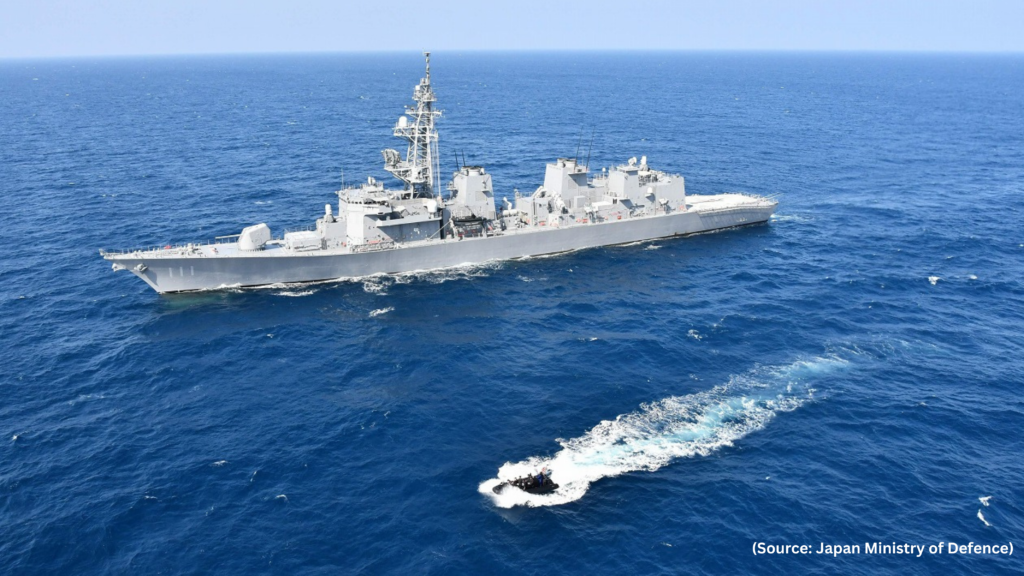
Japan has undergone a decisive strategic transformation — from a pacifist state constrained by constitutional limitations to a forward-leaning security actor projecting credible deterrence across the Indo-Pacific and beyond. Driven by China’s military assertiveness, North Korea’s nuclear brinkmanship, Russia’s revisionism, and shifting U.S. commitments under the Trump administration’s second term, Tokyo has embraced counter-strike capabilities, accelerated defense spending toward 2% of GDP, and embedded itself within a global web of defense-industrial partnerships. This paper examines the trajectory of Japan’s evolving military-strategic posture, its implications for Southeast Asia, and the diplomatic challenge of projecting hard power without eroding the trust painstakingly cultivated through decades of economic and soft-power engagement. It argues that Japan’s emerging strike capability represents not merely a technical upgrade but the crystallization of a new strategic doctrine — deterrence beyond defense.
The Indo-Pacific has evolved from a theater of economic competition and diplomatic maneuvering into a contested strategic space where hard power and military capability increasingly dictate regional influence. Japan’s transformation from a pacifist state constrained by constitutional limitations into a forward-leaning security actor marks one of the most consequential shifts in regional geopolitics since the end of World War II. This evolution is not abrupt but deliberate — an incremental recalibration of national identity and strategic posture in response to intensifying threats from China’s assertiveness, North Korea’s nuclear brinkmanship, Russia’s revisionism, and the recalibration of U.S. commitments under the Trump administration’s second term.
From a military-strategic perspective, Japan’s embrace of counter-strike capabilities, expanded defense spending, and integration into global defense-industrial networks signals a decisive departure from its post-war restraint. The acquisition of Tomahawk cruise missiles, Tokyo’s acceleration of the defense budget toward 2% of GDP, and its reciprocal access agreements with Australia, the Philippines, and the United Kingdom collectively underscore its commitment to projecting credible deterrence. Japan is no longer content to rely solely on the U.S. security umbrella; it is actively positioning itself as a central node in the Indo-Pacific’s evolving defense architecture. This military expansion is not merely reactive — it is a proactive instrument of statecraft. Japan’s outreach to Southeast Asia through the Official Security Assistance (OSA) scheme, its co-production of frigates with Indonesia, and its provision of patrol vessels to Vietnam reflect a calculated effort to embed itself in the region’s security fabric. Simultaneously, Tokyo’s participation in high-end projects such as the Global Combat Air Programme (GCAP) and its deepening ties with NATO and the European Union demonstrate its ambition to synchronize Indo-Pacific and Euro-Atlantic theaters, projecting deterrence across continents.
Yet Japan’s military build-up is tempered by historical memory and regional sensitivities. Southeast Asia’s trust in Japan, cultivated through decades of benign engagement, provides Tokyo with a unique strategic advantage — but one that must be carefully managed. A misstep in messaging or an overly aggressive posture risks alienating partners and reinforcing Beijing’s narrative of Japanese remilitarization.
In this context, Japan’s emerging strike capability represents more than a technical upgrade; it is the crystallization of a new strategic doctrine — deterrence beyond defense. It signals Tokyo’s intent to shape the Indo-Pacific order not only through diplomacy and economics but through credible military power, anchoring alliances, deterring adversaries, and redefining Japan’s role as a stabilizing force in an increasingly volatile region.
Since the end of World War II, Japan’s influence in Southeast Asia has been shaped primarily by its economic weight, diplomatic engagement, development assistance, and cultural appeal. These factors have underpinned Tokyo’s consistent standing as the region’s most trusted major power, as reflected in the ISEAS–Yusof Ishak Institute’s State of Southeast Asia annual surveys (SSEA). Yet even as this trust endures, the principal drivers of Japan’s influence — its economic and technological prowess — have been relatively displaced; the region’s economic gravity has shifted toward China, with South Korea also emerging as a competitive techno-industrial force.
Japan’s strategic relevance, however, is far from exhausted. Japan is emerging as a potentially consequential hard power player by steadily reshaping its strategic profile through increased deterrence capabilities and expanded security networks. Tokyo’s transition is incremental, calibrated, and shaped by systemic shifts in the regional and global security environment that have sharpened its threat perceptions.
Japan’s Changing Strategic Outlook and Hardening Security Posture
Japan’s strategic outlook has gradually shifted from an emphasis on shaping global governance through economic influence and multilateral engagement toward a more pragmatic realpolitik approach, driven by structural changes in its external environment. China’s rapid military build-up has fuelled its assertiveness in the East and South China Seas. Russia’s invasion of Ukraine laid bare the erosion of the rules-based international order. North Korea’s nuclear and missile threats continue unabated, and Pyongyang’s deepening ties with Moscow — alongside tightening Sino-Russian alignment — have sharpened Tokyo’s threat perception. Furthermore, the dramatic shift in U.S. foreign policy under the Trump administration’s second term has placed unprecedented pressure on allies such as Japan to shoulder greater defense responsibilities.
Japan’s embrace of the Free and Open Indo-Pacific (FOIP) concept, conceived by Prime Minister Shinzo Abe in 2012, signaled the beginning of this strategic turn. The concept was shaped by the imperative to counterbalance China’s power by anchoring a rising India within the constellation of U.S. allies and like-minded partners. The Abe government in 2014 approved a reinterpretation of the constitution permitting the Japan Self-Defense Force (JSDF) — comprising the JGSDF, JMSDF, and JASDF — to participate in collective self-defense missions when an ally is under attack.
The Kishida government’s 2022 National Security Strategy (NSS) and National Defense Strategy (NDS) were watershed documents, stating unambiguously that ‘Japan’s security environment is as severe and complex as it has ever been since the end of World War II,’ while asserting that Japan ‘will not tolerate unilateral changes to the status quo by force.’ Central to this shift were the development of counter-strike capabilities through the acquisition of Tomahawk cruise missiles and homegrown long-range missiles, and the increase in defense spending from the long-held cap of approximately 1% of GDP to 2% by 2027.
The Takaichi Acceleration — and Its Diplomatic Costs
Prime Minister Kishida’s successor, Sanae Takaichi, has accelerated this timeline by two years, with the 2% target now slated for fiscal year 2025 — a commitment she has already begun to operationalize. Japan’s Cabinet approved a record defense budget exceeding 9 trillion yen ($58 billion), up 9.4% from 2025, representing the fourth year of its five-year program to double annual arms spending. Defense Minister Koizumi framed the rationale in terms that directly echo the 2022 NSS: Japan faces ‘the severest and most complex security environment in the postwar era.’
As Abe’s ideological heir, Prime Minister Takaichi is expected to fast-track Japan’s security evolution. Within her first month in office, she advanced plans to establish a national intelligence agency, revise the 2014 Three Principles on Transfer of Defense Equipment and Technology to remove restrictions on lethal weapons exports, and expand domestic weapons manufacturing. Japan’s arms imports surged by 155% between 2019 and 2023, making it the sixth-largest weapons importer globally.
The episode was further complicated by Washington. President Trump reportedly advised Takaichi not to escalate tensions or provoke China over Taiwan sovereignty — a striking divergence from Tokyo’s posture, and one that publicly exposed the friction within the alliance that the paper’s authors had flagged as a structural risk. Japanese officials publicly disputed the account, but the incident underscored that the Trump administration’s ‘ally burden-sharing’ logic does not translate automatically into endorsement of Japanese strategic assertiveness vis-à-vis China.
An Emerging Defense Partner of Southeast Asia
Recognizing its constitutional constraints and the sensitivities surrounding its World War II history, Japan has pursued its more assertive security posture in close coordination with the United States and other like-minded partners. According to the Lowy Institute Asia Power Index 2024, Japan’s most significant improvement was in defense networks, where increased activity with the United States and other regional partners boosted its score by 13.1 points.
For Southeast Asia, Japan’s relevance as a defense partner has risen significantly — from 15th place in 2017 to 4th in 2025 — according to the Lowy Institute’s Southeast Asia Influence Index. Japan’s defense cooperation is particularly robust with the Philippines (46.5), Vietnam (43.3), Indonesia (39.9), Malaysia (39.7), and Cambodia (35.6). Military exercises with Southeast Asian states have expanded steadily since 2014, predominantly with maritime states such as Indonesia (18.8%), the Philippines (18.2%), Singapore (17.7%), and Malaysia (16.6%).
Japan’s provision of defense equipment to Southeast Asia has increased in recent years, facilitated in part by the OSA scheme. Launched in 2022, the OSA enables Japan to supply non-lethal defense equipment to partner countries. The Philippines has been the foremost beneficiary, receiving rigid-hulled inflatable boats, coastal radar systems, and air surveillance equipment. A landmark Japan-Philippines Reciprocal Access Agreement (RAA) entered into force in 2025, and growing strategic trilateral cooperation between Japan, the Philippines, and the United States has further institutionalized the partnership.
For Vietnam, Japan has been a valuable partner in strengthening maritime capabilities. In 2020, both countries signed an agreement for concessional loans worth US$348 million to finance six new patrol vessels. Under OSA, Malaysia has received rescue boats and surveillance equipment, while Tokyo is in discussions to co-produce advanced frigates with Indonesia — signaling Japan’s intent to project its defense-industrial capability through collaborative production.
Japan’s Global Strategic Networking
While Japan’s defense engagement with Southeast Asian countries remains formative, its parallel outreach beyond the region has greater strategic depth and more substantive operational cooperation. It is within this wider web of global partnerships that Japan is emerging as an increasingly consequential security actor.
Defense-Industrial Revival: GCAP and the Australia Frigate Deal
Tokyo is a leading participant in the UK-Italy-Japan Global Combat Air Programme (GCAP) to develop a sixth-generation fighter aircraft, slated for service entry in 2035. Japan plans to spend more than 160 billion yen ($1 billion) in 2026 on the joint development program alone. In 2025, Australia selected Japan’s Mitsubishi Heavy Industries to build a new fleet of eleven Mogami-class frigates — the largest defense deal in Japan’s history at US$6.5 billion. New Zealand has likewise signaled interest in Japan-built vessels. These advances are restoring Japan’s defense-industrial momentum after decades of stagnation.
Strike Capability: The Hardware Is Now Real
NATO, the EU, and Euro-Atlantic Linkages
As one of NATO’s four Indo-Pacific partners (IP4), Tokyo established its dedicated mission to NATO in 2025 and convened the first Japan-NATO dialogue on defense-industrial cooperation, focusing on emerging technologies, interoperability, and supply-chain security. With the European Union, Japan launched the Security and Defense Partnership in 2024 — covering maritime security, cyber, hybrid threats, counter-terrorism, non-proliferation, and peace operations — and held the inaugural Japan-EU Security and Defense Dialogue in 2025. In September 2025, the JASDF conducted its first-ever fighter deployment to Europe as part of the Atlantic Eagles mission.
Japan’s deepening defense engagement with Europe is driven by the conviction that ‘Ukraine today may be East Asia tomorrow.‘ Tokyo is one of Ukraine’s leading non-lethal aid sponsors, providing approximately US$15 billion since 2022. Japan also participated with France and the United States in maritime drills in the South China Sea in 2025, reflecting its role as a connective node facilitating Europe’s operational presence in the Indo-Pacific.
Australia, India, and the Quad Architecture
Japan maintains its closest Indo-Pacific military ties (outside the United States) with Australia. The Australia-Japan RAA — described as ‘Japan’s first defense treaty with an international partner since 1960’ — entered into force in 2023. It has facilitated over 40 joint activities and enabled the largest-ever Japanese participation of over 1,500 JSDF personnel in Exercise TALISMAN SABRE 2025. In 2025, Tokyo, Canberra, and Washington signed an important trilateral logistics agreement enabling reciprocal naval support, including refueling and missile reloading.
The 2025 Japan-India Joint Declaration on Security Cooperation deepened bilateral ties through enhanced use of the Acquisition and Cross-Servicing Agreement (ACSA), greater access to each other’s facilities for repair and maintenance, and expanded co-development of defense equipment. Notably, Japan is providing the Unified Complex Radio Antenna (UNICORN) — a low-observable integrated sensor system — for Indian warships.
Implications for Southeast Asia
Japan’s security and defense engagements with Southeast Asia have thus far been positively received, largely because they have been advanced cautiously — constrained by Japan’s own institutional limitations and calibrated to regional political realities. Tokyo recognizes that Southeast Asian countries maintain deep economic and diplomatic linkages with China and are wary of actions that might be perceived as overtly provocative to Beijing.
The SSEA shows that the share of respondents viewing ‘Japan’s military power as an asset for global peace and security‘ rose from just 1.5% in 2020 to 10.5% in 2025. A 2023 Japanese Ministry of Foreign Affairs survey found that 88% of Southeast Asian respondents support the JSDF’s more active role in regional peace, stability, and disaster management.
The Singapore Episode and the Limits of Regional Consensus
The differing perceptions of Japan between China and Southeast Asia became sharply visible in 2025. Beijing launched an extensive anti-Japan propaganda campaign to mark the 80th anniversary of the end of World War II. Initially focused domestically, the campaign expanded internationally after PM Takaichi’s Taiwan remarks. When Singapore’s Prime Minister Lawrence Wong stated that Singapore and Southeast Asia are ‘moving forward‘ from history and ‘support Japan playing a bigger role, including on the security front,’ his matter-of-fact statement was quickly politicized — exposing fault lines within Singaporean society, particularly among segments influenced by Chinese-language media.
This episode underscores that Southeast Asian states will increasingly be required to navigate both the pressures of Japan-China tensions and domestic sensitivities, where historical memory and external influence shape public perception in ways that complicate both domestic politics and foreign policy formulation. Beijing’s willingness to use economic coercion — freezing food imports, raising territorial claims over Okinawa and the Ryukyus — signals an escalatory toolkit that extends well beyond Southeast Asia and may be deployed to pressure regional states directly.
The NATO Overreach Risk
Tokyo’s efforts to link the Indo-Pacific and Euro-Atlantic security theaters risk conflating two strategically distinct regions and complicating already complex security dynamics. Southeast Asian countries generally welcome the presence of external powers but are wary of overtly confrontational approaches that could sideline ASEAN-led frameworks or draw them into bloc politics. Tokyo’s overtures — such as supporting NATO’s reach into Asia or former Prime Minister Ishiba’s proposal of an Asian NATO — appear poorly calibrated to Southeast Asian strategic sensitivities. They risk inadvertently reinforcing Beijing’s Cold War narrative while overlooking the nuanced hedging approaches characteristic of Southeast Asian states.
Conclusion
Southeast Asians’ trust in Japan rests on its benign image, cultivated through decades of economic, diplomatic, and soft-power engagement. This trust is unlikely to erode simply because Tokyo is gradually strengthening its defense capabilities: the prospect of a remilitarized Japan returning to territorial conquest is far-fetched, and the absence of shared borders, territorial disputes, or aggressive intent between Japan and the region reduces the perceived threat. For some Southeast Asian states, a stronger Japan may even serve as an implicit counterweight to China, particularly against the backdrop of declining U.S. engagement.
Nevertheless, Tokyo must proceed with care. A rearming Japan could invoke lingering historical memories, particularly among older generations. One development to watch closely is the ongoing debate over nuclear-powered submarines: if Japan were to pursue a comparable program to South Korea’s reported pursuit — and there is no certainty that it will, given Japan’s deeply ingrained nuclear taboo — it could provoke a highly assertive Chinese response, one that would invoke the Southeast Asia Nuclear-Weapon-Free Zone Treaty to pressure regional states, as Beijing did in response to AUKUS.
The evidence examined in this paper supports the thesis that Japan’s emerging strike capability constitutes not a marginal policy adjustment but a fundamental redefinition of national strategic doctrine. The integration of long-range precision strike systems — now confirmed through verified procurement of Type-12 missiles with a 1,000km range, SHIELD drone systems, and GCAP investment — represents a decisive break from decades of post-war restraint. What distinguishes this shift from simple defense modernization is its forward-looking logic: to deny adversaries the initiative, impose costs on aggression, and reassure allies of Tokyo’s reliability as a security partner.
For Southeast Asia, this trajectory introduces both opportunity and complexity. Japan’s calibrated provision of patrol vessels, radar systems, and maritime surveillance equipment strengthens regional resilience against coercion. At the same time, the acceleration of events since the Takaichi Taiwan remarks — Beijing’s economic pressure, territorial revisionism regarding the Ryukyus, Trump’s private counsel against escalation — suggests that Japan’s careful sequencing is already under stress. The central finding of this paper remains valid but demands urgency: Japan can sustain this balance — but only if it communicates and socializes its evolving role through measured messaging, sustained institutional outreach, and genuine respect for regional sensitivities. It is through these means, as much as through military hardware, that Southeast Asia will ultimately read Japan’s growing capabilities as a stabilizing and trustworthy presence.
NOTE ON SOURCES
Data on military exercises and defense cooperation indices are drawn from the Lowy Institute Asia Power Index (2024) and the Lowy Institute Southeast Asia Influence Index (2025). Public opinion data is drawn from the ISEAS–Yusof Ishak Institute’s State of Southeast Asia annual surveys (2020–2025) and the Japanese Ministry of Foreign Affairs regional survey (2023). Arms transfer figures are sourced from the Stockholm International Peace Research Institute (SIPRI). Financial data on Japan’s FY2026 defense budget, standoff missile procurement, SHIELD drone deployment, GCAP expenditure, and the Mitsubishi–Australia frigate contract are drawn from Reuters/AP wire reporting (December 2025). Diplomatic incident reporting on the Takaichi-Taiwan episode, Beijing’s retaliatory measures, and the China–Japan bilateral deterioration is sourced from Reuters (November–January 2025–26) and the Wall Street Journal (November 2025). All financial figures are in current U.S. dollars unless otherwise stated.
